Résumé:
About 1.8 Ga ago, cyanobacteria were phagocyted by eukaryotes, leading to primary endosymbiosis and giving rise to chloroplast. Since then, other eukaryotes have included photosynthetic eukaryotes (secondary/tertiary endosymbiosis), which appear to have evolved many times independently. Despite the ubiquity of photo-endosymbiosis in the environment, these early mechanisms remain widely unknown. The aim is to study the first steps leading to the maintenance of a photosynthetic organism within a eukaryote. To this end, we are using unicellular models, the host ciliate Tetrahymena thermophila and the photosynthetic alga Chlorella variabilis and the cyanobacterium Synechococcus elongatus. These models allowed us to study the selective advantage that phagocytosis of a photosynthetic organism can bring to its host under unfavorable conditions. The results show the importance of O2 for a better survival of T. thermophila having phagocytosed photosynthetic organisms in anaerobic conditions.
Mots clés:
Photosymbiosis, evolution, oxygen, phagocytosis.
Illustration:
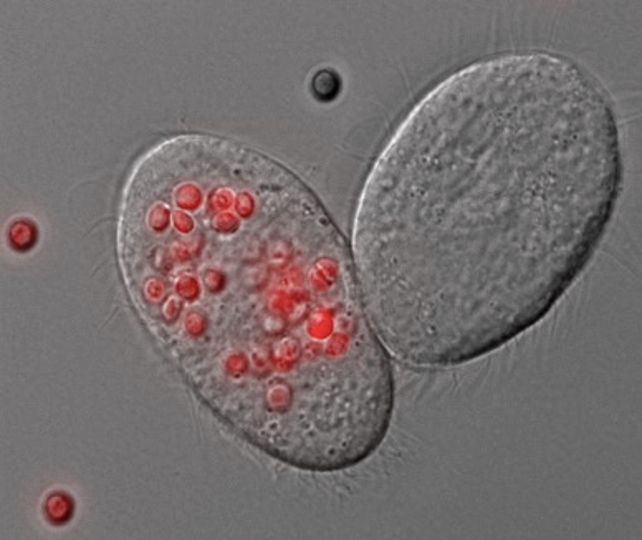
Tetrahymena thermophila (cilié) contenant des Chlorelles photosynthétiques, en microscopie à fluorescence (fluorescence de la chlorophylle). Crédits Leone Espinoza/Gael Brasseur