Porteur(s)
Johannes STUTTMANN
Laboratoire(s)
Institut de Biosciences et biotechnologies d'Aix-Marseille (BIAM)
2,4-diacetylphloroglucinol (DAPG) is a potent fungicide produced by Pseudomonas isolates (https://doi.org/10.3389/fmicb.2017.01218). Indeed, suppression of Take-all disease, caused by the ascomycete Gaeumannomyces graminis var. tritici, in disease suppressive soils has been repeatedly associated with an increased abundance of DAPG-producing bacterial strains (https://doi.org/10.1016/j.soilbio.2012.05.012). Accordingly, DAPG-producing bacteria have potential as biocontrol agents. In this project, we aimed to evaluate the direct use of DAPG as a biosourced fungicide to circumvent drawbacks of products based on living bacteria.
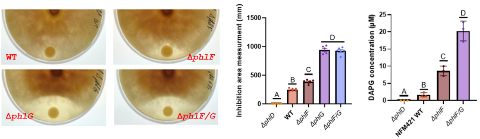
A major aim was to investigate possible bioproduction of DAPG. To identify a suitable bacterial chassis, we screened twenty-one Pseudomonas strains, selected from a previous large-scale screen, for antifungal properties. We showed, by mutations in the gene coding for the enzyme catalyzing the committing step in DAPG biosynthesis, phlD, that antifungal properties in three best-performing strains were based on DAPG production. We further improved DAPG production, by approximately a factor four, by inactivation of a repressor (PhlF) and a hydrolase (PhlG). In yet another approach to manipulate DAPG production, we designed and assembled a synthetic gene cluster encompassing the phl genes for DAPG biosynthesis. The synthetic gene cluster, when inserted into a non DAPG-producing Pseudomonas strain, confers antifungal properties. The modular design of the synthetic cluster will allow us to further manipulate DAPG production and content, as promoters driving individual transcription units can be exchanged with ease following standardized assembly reactions. Last, we assayed DAPG biocontrol capacities in plate assays, and observed that DAPG doses efficient as fungicide (≥ 20 µM) also impede plant growth and development. Considering the natural biocontrol capacities of DAPG-producing bacteria in the field, we will address the feasibility and efficacy of DAPG in seed coatings to protect from fungal diseases in the future.
Augmentation of DAPG content in a naturally occurring Pseudomonas isolate for improved antifungal capacities (Credits : Maxence GIRADIN and Johannes STUTTMANN)
Voir l'appel à projet correspondant