Laboratoire(s)
Institut de Biosciences et biotechnologies d'Aix-Marseille (BIAM)
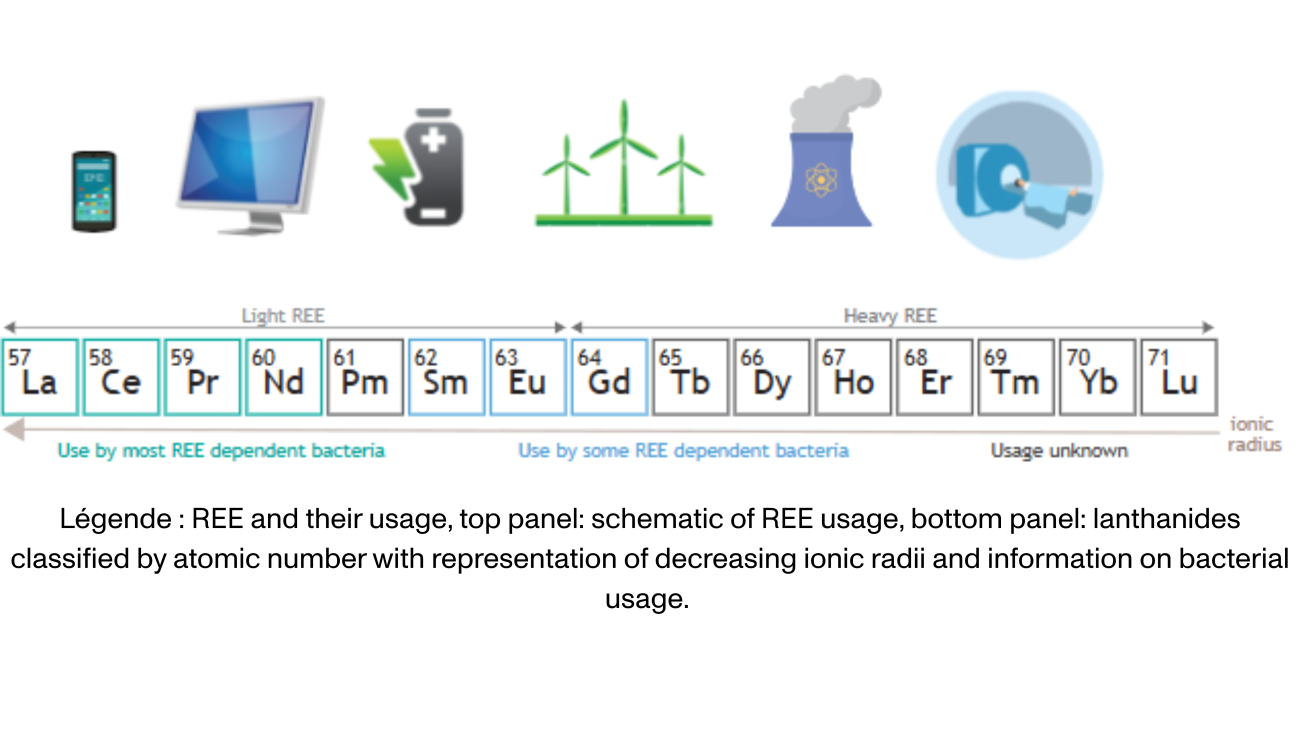
Lanthanides (Ln) also known as Rare earth elements (REE) possess chemical, magnetic, luminescent and electric properties of high interest in the industry, medicine and renewable energy. REE are critical resources for the high technologies of ever-growing interest (Figure1). REE are common metals (0.5 to 60 ppm) of the Earth’s crust but are most often found in mixture. Due to their close physicochemical properties, their selective extraction is a challenge. Classic extraction and separation methods required several steps (up to 100) and generate a lot of pollutant wastes. Alternative methods to obtain more efficient and more sustainable REE extraction that selective are highly needed. Bio-inspired tools are the actual most promising options. Indeed, in the past decades, studies on bacterial system suggest that REE biochemistry could solve the selectivity issue. Only the light REE (La to Eu) are naturally used by bacteria, indicating that bacteria are able to selectively discriminate between REE. More broadly, those discoveries open a new field of research for which much is to be uncovered.
The first REE-interacting protein identified was the methanol dehydrogenase (MDH) of a methylotroph bacteria. Further investigations revealed that methylotroph bacteria also possess other REE interacting proteins, consequently most of the work focused on methylotroph’s proteins. To date three binding sites of REE-interacting protein have been characterized (XoxF, LanM and LanD), some present a preference trend toward light REE but limit of the selectivity is not fully understood yet. Conservation analysis revealed that MDH like proteins are more widespread among bacteria than initially thought. This opened the way for new investigations in other bacteria. Interestingly, for at least some organisms carrying the two forms of methanol/alcohol desydrogenases, i.e. calcium (Ca2+) or REE dependent. The regulation allowing the bacterial adaptation leading to the expression switch in between the two forms of MDH/ADH, is under the control of a complex regulatory network involving two-component systems (TCS), and in some case other proteins. Importantly, TCS involved in the REE adaptation seems to be among the most selective and vary from organisms revealing that selective detection mechanisms might differ between bacteria. None of those detailed molecular mechanism involved in the REE detection has been uncover.
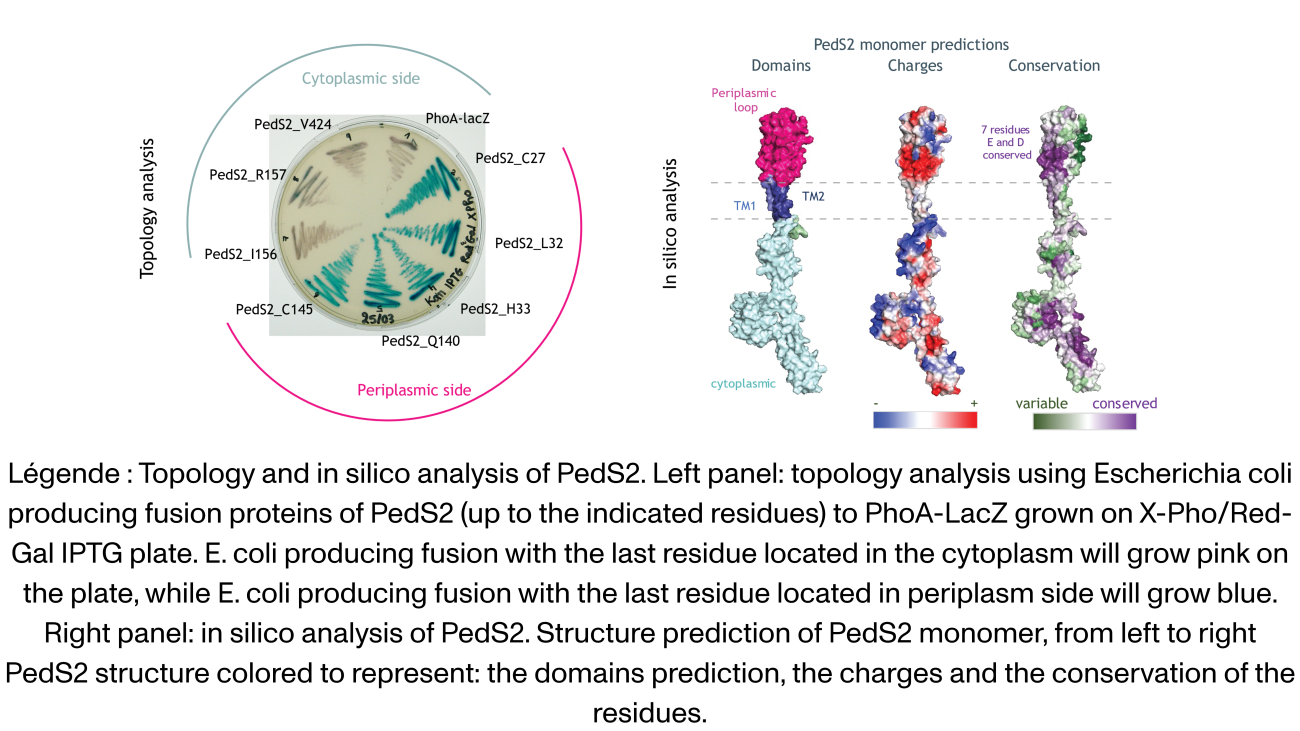
Few recent studies done by IPM collaborator P. Billard (Univ. Lorraine) in the non-methylotroph bacteria Pseudomonas putida, confirmed the broader conservation of REE proteins. Among them the two-component system (TCS) called PedS2/PedR2, in charge of the regulation switch between the two alcohol deshydrogenases (REE or Ca2+ dependent), for which the detailed REE detection mechanism is not fully understood (Figure2). The regulon of this TCS is not identified either. Deciphering the molecular mechanism used by this TCS to first sense the REE, either indirectly or directly, discriminate and then regulate the targeted genes is key to broaden the knowledge on REE adaptation.
The aim of this project is to characterize for the first time the molecular mechanism involved in the bacterial REE sensing using P. putida as model. To this end, the strategy is to purify PedS2 protein and identify the REE detection mechanism using a combination of approaches to provide insights on the potential key residues involved in the REE sensing. Following the PedS2 characterization, the goal is to further investigate the PedR2 regulon and its binding properties. Thanks to the IM2B grant, we have been able to test in vivo potential PedS2 interacting partner, validate the PedS2 topology (Figure3), notably the sensor loop, purified the PedS2 sensor loop, initiate the in vitro characterization of PedS2 REE detection mechanism with preliminary results suggesting a direct binding. In other proteins, REE binding is coordinated by carboxylate residues. Next, we realized an in silico analysis to predict potential residues involved in the binding (Figure3).