However, despite this outstanding potential, SEIRA spectroelectrochemistry faces limitations mainly arising from the nature of the biological sample itself. In fact, it is nearly impossible to rely exclusively on intrinsic infrared markers of the protein to elucidate structural or environmental variations at a local level. Consequently, evaluating the immobilised redox enzyme orientation or observing protein dynamics is difficult as it is hampered by the global response of the protein amide bands. Similarly, monitoring catalysis at the redox active site is restricted to only a handful of enzymes.
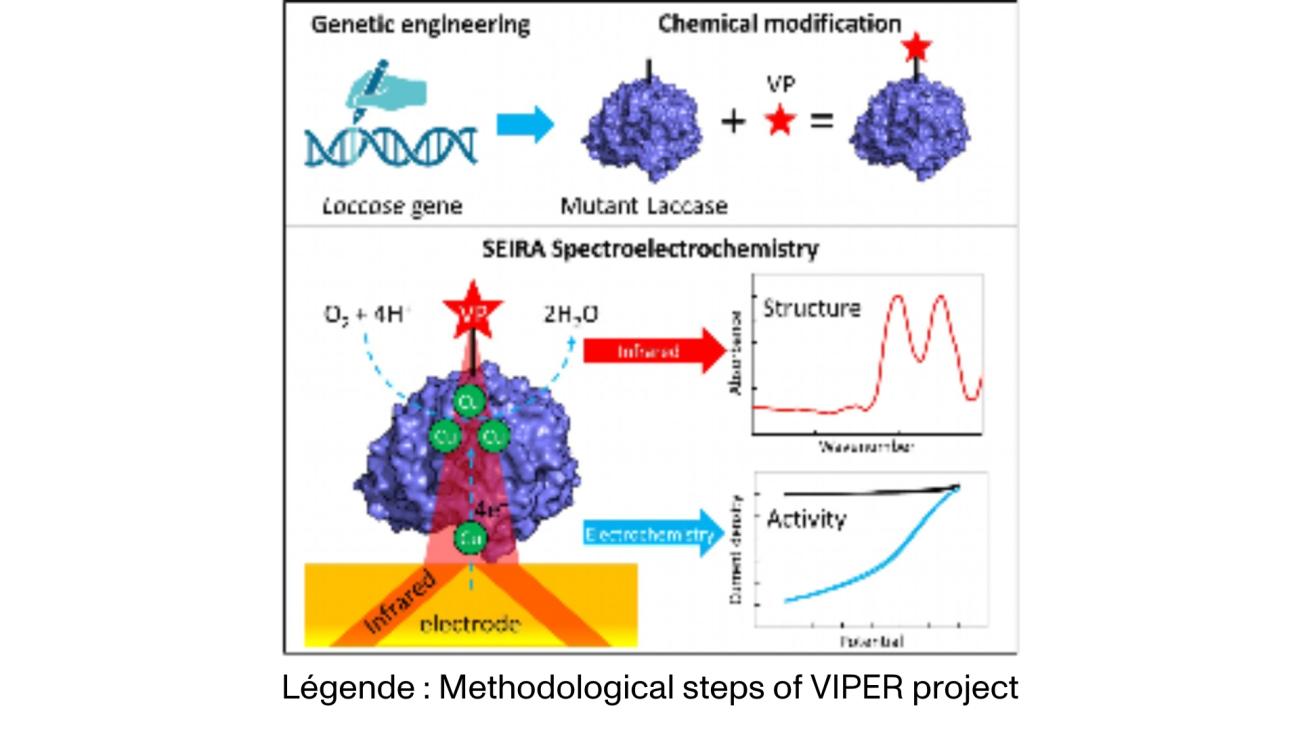
The VIPER project aims at lifting off those limitations for: (1) improving SEIRA resolution and (2) broadening the range of investigable redox enzymes. The methodology will rely on the introduction of site-specific Vibrational Probes (VPs), into a model redox enzyme (Laccase). Vibrational probes are small molecules which vibrational mode is sensitive to its immediate environment in terms of electrostatics and H-bonding. Laccase catalytic activity couples the one-electron oxidation of a wide range of organic and inorganic substrates to the four-electron reduction of molecular oxygen into water. We will decipher the orientation - activity relationships of laccase upon immobilisation onto electrodes. We will subsequently monitor its structural dynamics at a localised level and ultimately probe the various states of its catalytic cycle. This interdisciplinary project will pave the way for the spectroelectrochemical characterisation of poorly or yet uncharacterised redox enzymes.
General scheme of VIPER project (Credits: Alexandre CIACCAFAVA)