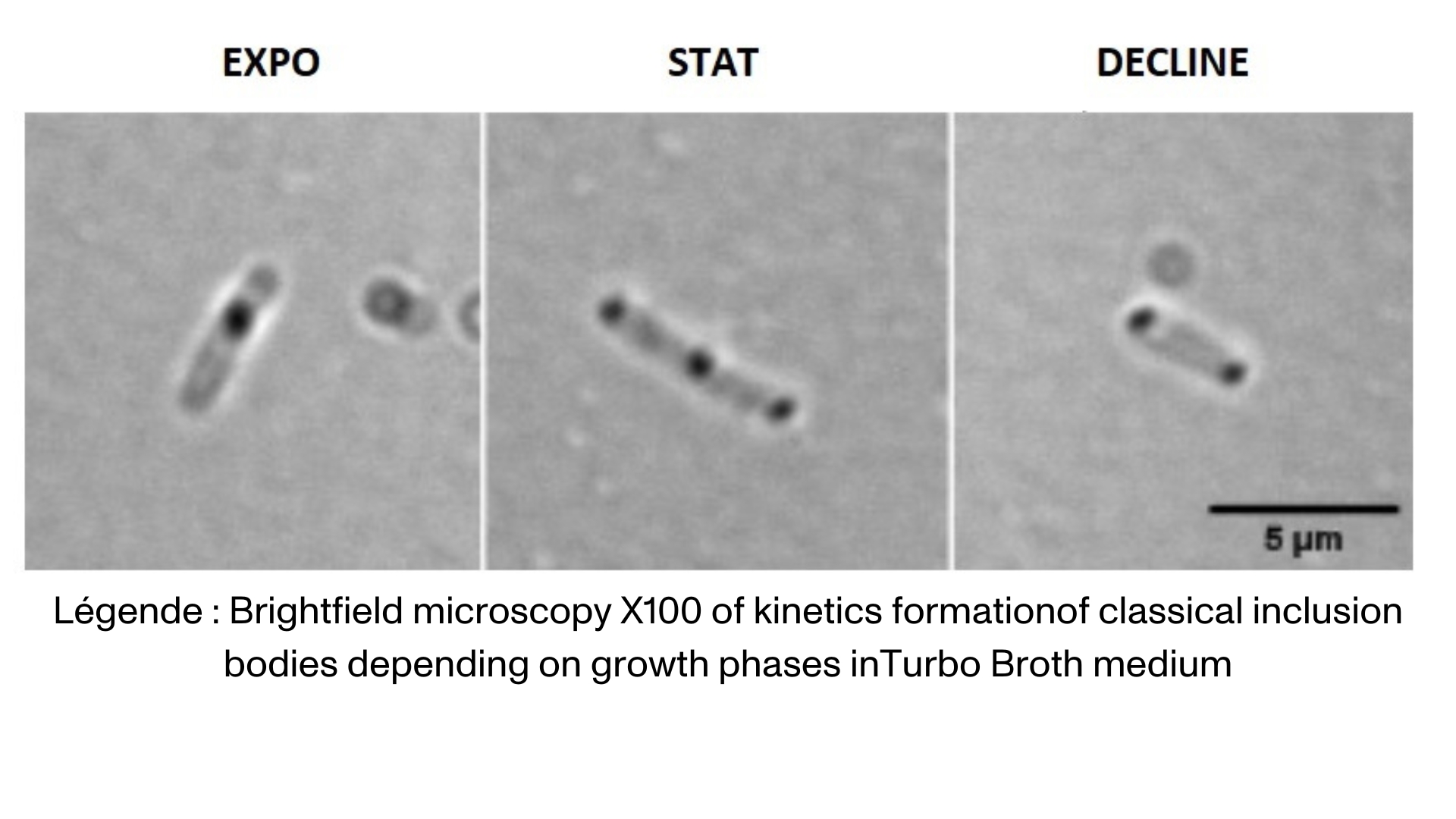
Recombinant protein expression in cells often leads to the Training of inclusion bodies (IBs), aggregates traditionally viewed as containing denatured, inactive proteins (Mayer & Buchner, 2003). However, recent studies have challenged this perception by revealing that IBs can harbor a significant portion of the cell's total protein content, with up to 95% purity. This dichotomy in IB composition distinguishes classical inclusion bodies (IBsC), characterized by compact, amorphous structures, from non-classical inclusion bodies (ncIBs), which exhibit a higher proportion of correctly folded proteins, facilitating their extraction and solubilization (Bucciantini et al., 2002); (Upadhyay et al., 2012).
This study focuses on delineating the parameters distinguishing classical IBs from ncIBs and optimizing production methods for proteins prone to aggregation. Through microscopic analysis, dynamic light scattering (DLS), and thermodynamic studies, we elucidated the distinct characteristics of these inclusion bodies. Our findings reveal that classical IBs form dense structures within bacteria, impacting cell division and localization, whereas ncIBs exhibit diffuse morphology in the cytoplasm. Moreover, while classical IBs necessitate denaturing agents for solubilization, hindering protein yields, ncIBs offer a promising alternative with their porous, less dense assembly, facilitating extraction using non-denaturing agents. By exploiting this distinction, we demonstrate the transformation of classical IB production into ncIB thereby enhancing yields of recalcitrant proteins.
Our results, supported by molecular, structural and biophysical techniques, underscore the potential of ncIBs as a platform for diverse protein production, offering avenues for enhancing yields and addressing challenges associated with hydrophobic and disordered proteins.
Classical Inclusion Bodies (Credits Yasmina Bouzariouh & Hugo Le Guenno)