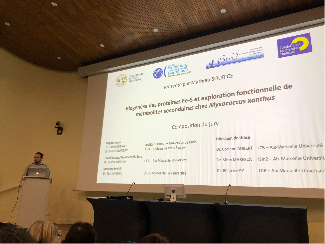
Abstract:
Bacteria produce small molecules known as secondary metabolites, which interest research for their numerous therapeutic properties and their role within the biotope. Myxobacteria are Gram-negative bacteria described as multi-producers of secondary metabolites. However, their identification and production in the laboratory is complex. During my thesis, I used the myxobacterium, M. xanthus, to develop a 2PRIM-BOOST approach, which combines optimization of the M. xanthus culture protocol and synthetic biology. The advantages of this approach are an accumulation of compounds involved in the biosynthesis of secondary metabolites, and a simplified metabolome facilitating structural identification and the demonstration of biological activities. As a proof of concept, the combination of the different tools enabled us to significantly increase myxoprincomide production. Once validated, this method enabled me to discover a new metabolite, and analogues, which remain to be characterized. For their biosynthesis, some metabolites require proteins with an Fe-S cofactor. I have studied the process of Fe-S protein biogenesis in M. xanthus and discovered a genetic context in which the expression of Fe-S cluster biogenesis machineries is maximal. All my work will be used to identify unknown secondary metabolites of M. xanthus, and more broadly those of myxobacteria, whether or not they depend on Fe-S proteins.
Co-supervisors :
- Corinne AUBERT (LCB)
- Marc MARESCA (iSm2)
- Béatrice PY (LCB)