Organized on the initiative of students in Aix-Marseille Université's microbiology master's program and supported by the Microbiology, Bioenergies and Biotechnology Institute, the "AI and I" symposium illustrates the dynamism of the program and its ability to seize on major contemporary scientific changes. This collective brainstorming has resulted in an acclaimed publication in the journal Médecine/Sciences.
On November 13, 2025, the Luminy campus welcomed nearly 80 participants - students, teacher-researchers and researchers - who came together with a common goal: to compare their uses and expectations of artificial intelligence in microbiology. The event was prompted by a strong desire on the part of students to understand, discuss and support a technology that is now ubiquitous in academic and scientific practice.
Collective construction for training purposes
The "AI and I" symposium stands out for its original organization, carried out jointly by students and researchers from the IM2B perimeter. The students actively contributed to defining the themes, integrating current issues such as theenvironmental impact of AI and its applications in healthcare and biomedicine.
This co-construction process has enabled us to offer a program rooted in the real concerns of the academic community, fostering direct exchanges between the various players involved in training and research.
Confronting uses to better understand issues
The day was designed as a forum for dialogue. Presentations and round tables highlighted the diversity of AI uses:
- for students, an everyday tool for learning, revision and production ;
- for teacher-researchers, a pedagogical challenge requiring adaptation of practices;
- for researchers, a powerful lever for innovation, particularly in biomedicine.
Over and above their uses, the discussions raised a number of essential questions: dependence on tools, scientific integrity, environmental costs and the place of critical thinking in a context of increasing automation.
Scientific promotion in Médecine/Sciences
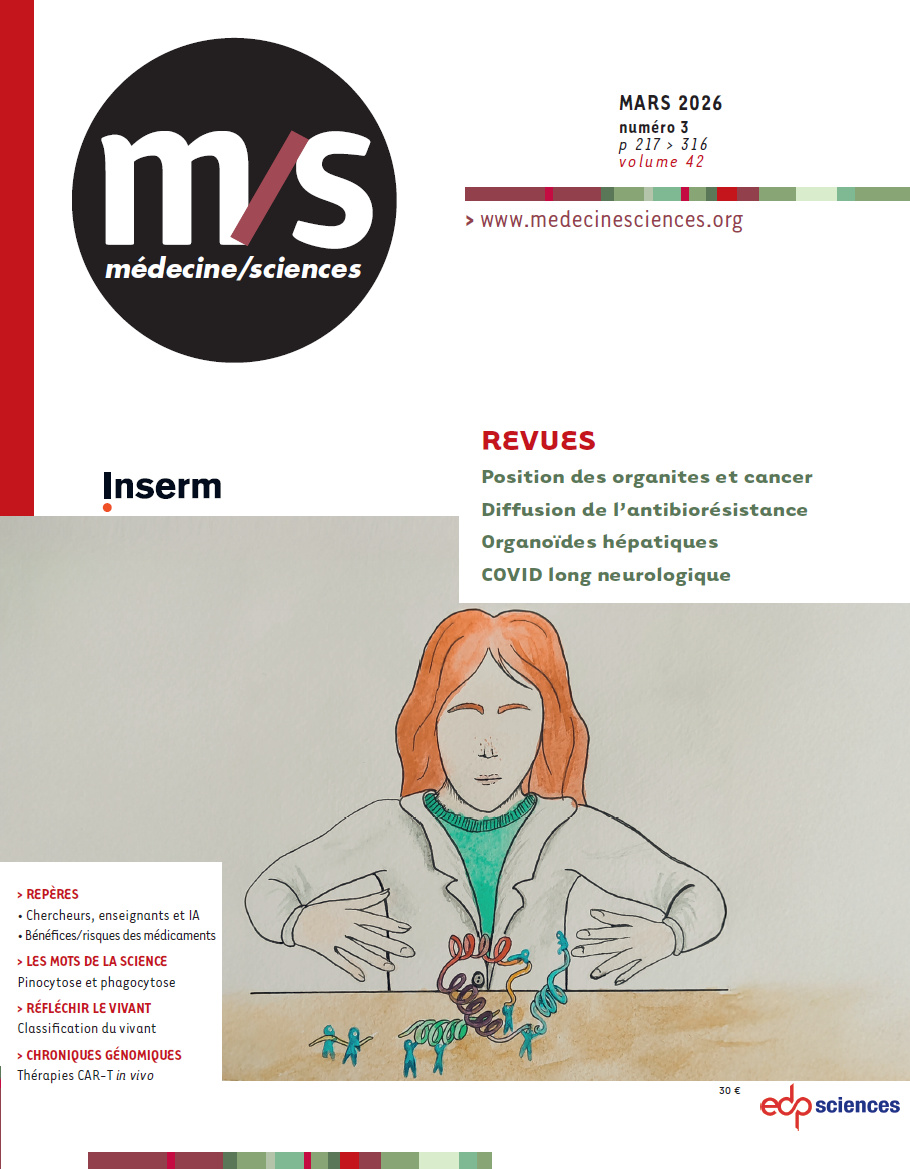
The reflections arising from this symposium were extended by the publication of an article written by Laurent Aussel in the journal médecine/sciences, in the "Nos jeunes pousses" section.
This article offers a structured summary of the transformations brought about by generative AI in the academic world. It puts different points of view into perspective, while opening up major societal issues, particularly in the field of biomedicine. Drawing on a rich and up-to-date bibliography, it is also a valuable resource for contemporary debates.
Laurent Aussel points out that the use of AI by students is highly heterogeneous, ranging from "assistance" to dependence, but that "many students use AI primarily as a tool to assist learning". On the teaching-research side, he highlights the impact of the rapid emergence of artificial intelligence tools, particularly in student assessment. On the other hand, Laurent Aussel emphasizes the interest of teachers in this "powerful assistant for pedagogical innovation". As for researchers, the head of training indicates that the tool is already well integrated, particularly in terms of its predictive power, with the example of AlphaFold. Laurent Aussel concludes his article by opening up the outlook: "The advent of AI is not simply a technical evolution, it is also a profound epistemological rupture that is redrawing the boundaries of knowledge production and transmission".
IM2B, a key player in educational innovation
Through this initiative, the IM2B confirms its role as an interface between education and research. By promoting student involvement and encouraging dialogue between disciplines and statuses, the institute is helping to train scientists who are capable of tackling technological transformations with hindsight and high standards.
The "AI and I" symposium is a concrete illustration of this: a space for experimentation, reflection and innovation, in the service of a science that is both effective and responsible.


